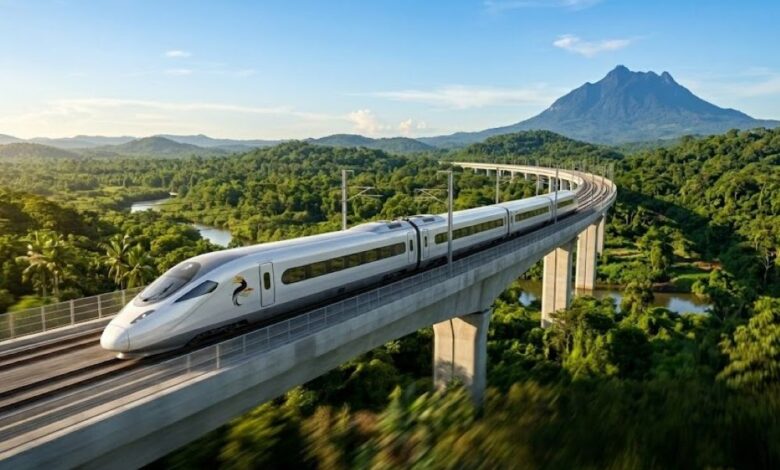
The Trans-Borneo Railway has reached a pivotal milestone as Malaysia’s Transport Minister, Anthony Loke, officially received the interim feasibility report for the mega-project.
This ambitious rail network is set to redefine connectivity across Borneo, bridging Malaysia, Brunei, and Indonesia.
By linking Sarawak, Sabah, and Kalimantan, the project signals a new era of regional integration and economic cooperation in Southeast Asia.
The ongoing feasibility study for the Trans-Borneo Railway, which launched in mid-2025, explores a massive 1,620km rail line designed to connect the Malaysian states of Sarawak and Sabah with Brunei and the Indonesian province of Kalimantan.
This infrastructure is increasingly strategic as Indonesia continues the development of its new capital, Nusantara, in East Kalimantan, creating a massive demand for efficient cross-border logistics.

Minister Anthony Loke emphasized that while the Trans-Borneo Railway is a transformative mega-project, it remains a long-term vision.
Implementation is expected to take several decades to fully realize, though the foundation for this cross-border integration is being laid today.
The minister noted that the scale of the project requires a forward-thinking approach that prioritizes stability and sustainable growth over immediate completion.
To ensure the project serves as a true catalyst for regional development, the Minister advised that the study must align the Trans-Borneo Railway routes with the long-term economic goals of both Sarawak and Sabah.
This alignment is intended to ensure that the infrastructure supports local industries, improves community accessibility, and matches the broader developmental master plans of the East Malaysian states.
The potential for the Trans-Borneo Railway to integrate with existing local urban projects, such as the Kuching Urban Transportation System (KUTS), adds another layer of value. Such a connection would create a seamless transition between international rail travel and local transit, significantly boosting tourism, trade efficiency, and the movement of goods across the island of Borneo.
With the final feasibility report for the Trans-Borneo Railway due in mid-2026, the focus now remains on stakeholder engagement and environmental considerations.
Information souorce: Anthony Loke Facebook